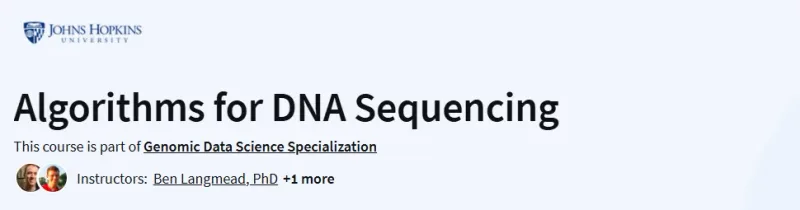
What will you in the Algorithms for DNA Sequencing Course
-
Understand the core principles of DNA sequencing and its computational challenges
-
Implement string matching and alignment algorithms
-
Calculate and interpret Hamming and edit distances
-
Build and apply k-mer indexing, suffix arrays, and overlap graphs
-
Perform genome assembly using de Bruijn graphs
-
Apply Python programming in bioinformatics workflows
Program Overview
1. DNA Sequencing, Strings, and Matching
Duration: 4 hours
-
Overview of DNA sequencing technologies
-
Introduction to genome representation as strings
-
Understanding sequencing errors and quality scoring (FASTQ format)
-
Implementation of naive exact string matching in Python
2. Preprocessing, Indexing, and Approximate Matching
Duration: 3 hours
-
Application of the Boyer-Moore algorithm
-
Building k-mer indices and hash tables for genome search
-
Understanding approximate matches using the pigeonhole principle
-
Introduction to Hamming distance and edit distance
3. Edit Distance, Assembly, and Overlaps
Duration: 3 hours
-
Dynamic programming for edit distance calculation
-
Local and global sequence alignment
-
Principles of shotgun sequencing and read overlaps
-
Construction and analysis of overlap graphs
4. Algorithms for Assembly
Duration: 3 hours
-
Shortest common superstring and greedy algorithms
-
Introduction to de Bruijn graphs and their application in genome assembly
-
Eulerian paths and practical genome assembly considerations
Get certificate
Job Outlook
-
Bioinformaticians: Strengthen algorithmic problem-solving skills in genomics
-
Molecular Biologists: Gain computational tools for analyzing DNA sequences
-
Software Engineers: Develop efficient genome data pipelines
-
Students and Researchers: Build foundational skills for advanced bioinformatics research
-
Data Scientists: Expand skillset into biological data modeling
Explore More Learning Paths
Deepen your algorithmic knowledge and explore applications in DNA sequencing and computational biology with these related courses and resources. These learning paths will strengthen your problem-solving skills and technical expertise.
Related Courses
-
Algorithms Specialization
Master the fundamentals of algorithms and data structures, forming the foundation for tackling complex computational problems. -
Advanced Learning Algorithms
Learn advanced algorithmic techniques and their practical applications, essential for handling large datasets and intricate problems. -
Algorithms on Strings
Focus on string algorithms, crucial for text processing, bioinformatics, and sequencing challenges in DNA analysis.
Related Reading
-
What Is Python Used For
Discover how Python supports algorithm implementation in fields like DNA sequencing, bioinformatics, and data-driven research projects.