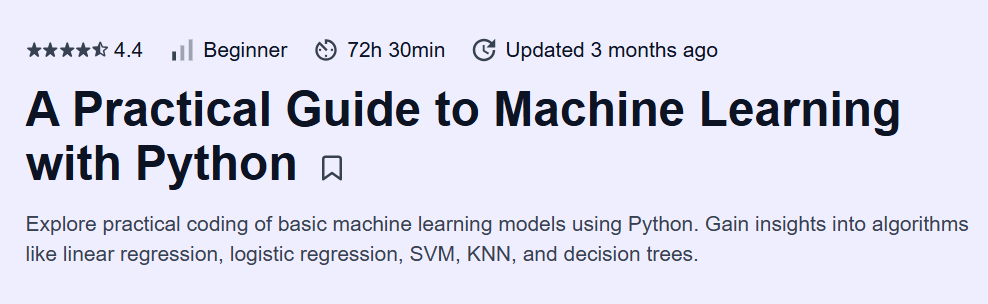
What will you learn in A Practical Guide to Machine Learning with Python Course
-
Implement core machine learning algorithms in Python: linear regression, logistic regression, decision trees, random forests, SVMs, K-NN, and ensemble methods
-
Perform exploratory data analysis and preprocessing: handling missing values, feature scaling, one-hot encoding, and dimensionality reduction (PCA, clustering)
-
Validate and tune models using train/test splits, k-fold cross-validation, and hyperparameter search (grid/randomized search)
-
Build end-to-end predictive pipelines: data ingestion, model training, evaluation metrics, and deployment considerations
Program Overview
Introduction & Setup
⏳ 30 minutes
-
Topics: Course objectives, Python ML ecosystem (NumPy, pandas, scikit-learn), Jupyter notebook setup
-
Hands-on: Configure your environment and load a sample dataset
Exploratory Data Analysis
⏳ 2 hours
-
Topics: DataFrame operations, summary statistics, visualization with Matplotlib/Seaborn
-
Hands-on: Profile a dataset—identify distributions, outliers, and correlations
Data Preprocessing
⏳ 2 hours
-
Topics: Handling missing data, encoding categorical features, feature scaling (StandardScaler, MinMaxScaler)
-
Hands-on: Clean and transform data for modeling, build a reusable preprocessing pipeline
Unsupervised Learning & Feature Engineering
⏳ 2 hours
-
Topics: K-Means clustering, PCA for dimensionality reduction, feature construction
-
Hands-on: Cluster customers for segmentation and reduce feature space with PCA
Model Evaluation & Validation
⏳ 1.5 hours
-
Topics: Train/test split, k-fold cross-validation, evaluation metrics (MAE, MSE, accuracy, ROC AUC)
-
Hands-on: Compare multiple models on a benchmark dataset using cross-validation
Regression Algorithms
⏳ 3 hours
-
Topics: Linear regression, regularized regression (Ridge, Lasso), tree-based regressors
-
Hands-on: Predict housing prices; tune hyperparameters with GridSearchCV
Classification Algorithms
⏳ 3 hours
-
Topics: Logistic regression, K-NN, SVM, decision trees, random forests, gradient boosting
-
Hands-on: Build a classification pipeline for a medical-diagnosis dataset; evaluate with confusion matrices and ROC curves
Advanced Topics & Ensemble Methods
⏳ 2 hours
-
Topics: Bagging, boosting (AdaBoost, XGBoost), stacking, handling imbalanced classes with SMOTE
-
Hands-on: Improve model performance through ensemble stacking and balance techniques
Model Deployment & Next Steps
⏳ 1 hour
-
Topics: Saving models with joblib, basic Flask API for serving predictions, tips for production readiness
-
Hands-on: Wrap a trained model in a simple REST endpoint for real-time inference
Get certificate
Job Outlook
-
Data Analyst / ML Engineer: $85,000–$130,000/year — leverage ML to drive data-driven decisions in tech, finance, healthcare
-
Data Scientist: $95,000–$150,000/year — build and deploy predictive models to solve business problems
-
Machine Learning Engineer: $100,000–$160,000/year — productionize ML pipelines and scale machine learning solutions
Explore More Learning Paths
Enhance your practical machine learning expertise by building, training, and deploying intelligent models using Python. These related courses will help you advance from foundational ML concepts to real-world production systems and cloud-based AI solutions.
Related Courses
-
Applied Machine Learning in Python Course — Learn how to implement core ML algorithms, evaluate model performance, and work with Python’s most powerful data libraries.
-
Advanced Machine Learning on Google Cloud Specialization Course — Master cloud-based ML workflows and scalable model deployment using Google Cloud tools and TensorFlow.
-
Production Machine Learning Systems Course — Understand how to transition models from research to production, ensuring reliability, scalability, and performance in real-world environments.
Related Reading
-
What Is Data Management? — Discover how organized and high-quality data serves as the foundation for building accurate, efficient, and reliable machine learning systems.