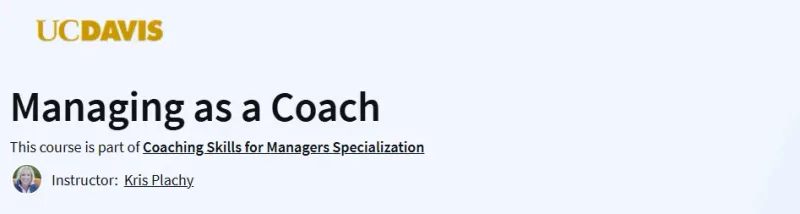
Managing as a Coach Course

Managing as a Coach Course Course

An insightful course that effectively bridges theoretical concepts with practical applications in coaching, ideal for professionals aiming to enhance their managerial effectiveness.

Explore This Course Quick Enroll Page
9.6/10 Highly Recommended

Managing as a Coach Course on Coursera — An insightful course that effectively bridges theoretical concepts with practical applications in coaching, ideal for professionals aiming to enhance their managerial effectiveness.

Pros

  • Taught by experienced instructors from the University of California, Davis
  • Hands-on assignments reinforce learning and provide practical experience.
  • Flexible schedule suitable for working professionals.
  • Provides a shareable certificate upon completion.

Cons

  • Requires prior experience with basic management concepts.
  • Some advanced topics may be challenging without a strong background in leadership principles.

Managing as a Coach Course Course

Platform: Coursera

Instructor: University of California

What will you in Managing as a Coach Course

  • Differentiate between managerial roles: coach, mentor, leader, manager, and trainer.

  • Understand the importance of coaching in modern management.

​​​​​​​​​​

  • Develop self-awareness and adaptability in leadership styles.

  • Apply the Thought Model to enhance employee performance and decision-making.

Program Overview

1. Course Introduction & What is Coaching?
⏳ Duration: 2 hours
Defines coaching and contrasts it with other managerial roles, providing examples and common pitfalls associated with each. 

2. Why Managers Must Develop Basic Coaching Skills
⏳ Duration: 2 hours
Explores the necessity of coaching skills in management and discusses why many managers don’t coach 

3. Points of View of Leadership
⏳ Duration: 2 hours
Examines how personal experiences influence management approaches and introduces the Thought Model. 

4. Course Peer Review Assignment
⏳ Duration: 6 hours
Provides an opportunity to practice the Thought Model and reflect on the course learnings through a peer-reviewed assignment.


Get certificate

Job Outlook

  • Enhances qualifications for roles such as Team Leader, Project Manager, and HR Manager.

  • Applicable in industries focusing on leadership development and employee engagement.

  • Provides practical coaching skills to improve team performance and communication.

  • Supports career advancement in fields requiring effective people management.

Explore More Learning Paths

Elevate your leadership and coaching abilities with these curated programs designed to help managers inspire, guide, and develop high-performing teams effectively.

Related Courses

Related Reading

  • What Is Performance Management? – Gain insights into performance management systems and how coaching plays a critical role in achieving organizational goals.
FAQs

Will this course help me if I struggle with employee motivation?
Teaches how to identify motivational blockers. Encourages active listening to employee needs. Equips managers to give constructive feedback. Provides strategies to align personal goals with company goals. Builds a positive and growth-oriented team culture.
How does the “Thought Model” help in workplace management?
Helps managers understand how thoughts drive behavior. Encourages self-awareness in decision-making. Improves conflict resolution through structured reflection. Guides employees to take ownership of outcomes. Enhances problem-solving and productivity.
What industries value coaching-based management the most?
HR and talent development roles highly value it. Project management in tech and consulting industries. Healthcare and education sectors emphasize people management. Startups benefit from adaptable leadership approaches. Customer service and sales teams thrive with coaching culture.
Do I need to be in a leadership role to benefit from this course?
Coaching principles apply at all organizational levels. Improves peer-to-peer collaboration. Helps in mentoring colleagues informally. Builds soft skills useful in job interviews and networking. Prepares learners for future leadership opportunities.
How is coaching different from traditional management?
Coaching emphasizes guiding rather than directing. Traditional management often focuses on tasks and control. Coaching builds trust and self-reliance in employees. Managers as coaches encourage reflection and problem-solving. It fosters long-term growth instead of short-term compliance.

Similar Courses

Other courses in Business & Management Courses