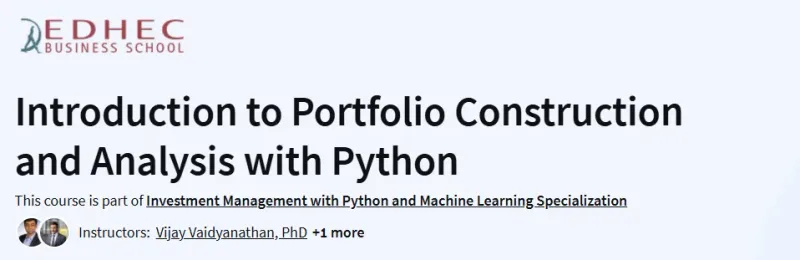
What will you in Introduction to Portfolio Construction and Analysis with Python Course
-
Gain an intuitive understanding of the theory behind modern portfolio construction techniques.
-
Write custom Python code to estimate risk and return parameters.
-
Utilize powerful Python optimization libraries to build scientifically and systematically diversified portfolios.
-
Build custom utilities in Python to test and compare portfolio strategies.
Program Overview
1. Analysing Returns
⏱ Duration: ~6 hours
-
Understand the fundamentals of returns and risk-adjusted performance measures.
-
Explore measures like Max Drawdown, Value at Risk (VaR), and Conditional VaR (CVaR).
-
Hands-on lab sessions to implement these concepts in Python.
2. An Introduction to Portfolio Optimization
⏱ Duration: ~4 hours
-
Learn the basics of portfolio optimization and the efficient frontier.
-
Implement optimization techniques using Python.
-
Understand the trade-off between risk and return in portfolio construction.
3. Beyond Diversification
⏱ Duration: ~6 hours
-
Delve into advanced topics like factor models and style analysis.
-
Explore the limitations of traditional diversification.
-
Implement advanced diversification techniques in Python.
4. Introduction to Asset-Liability Management
⏱ Duration: ~6 hours
-
Understand the principles of asset-liability management (ALM).
-
Explore strategies to manage financial risks associated with liabilities.
-
Implement ALM strategies using Python.
Get certificate
Job Outlook
-
Equips professionals with practical skills in portfolio construction and risk management.
-
Applicable to roles in investment management, financial analysis, and asset management.
-
Enhances proficiency in Python programming for financial applications.
Explore More Learning Paths
Enhance your investment analysis and portfolio management skills with these curated programs designed to help you build, evaluate, and optimize investment portfolios using practical tools and techniques.
Related Courses
-
Portfolio and Risk Management Course – Learn how to manage investment portfolios, assess risk, and apply quantitative methods for informed decision-making.
-
Investment and Portfolio Management Specialization Course – Explore strategies to construct and manage diversified portfolios, optimize returns, and evaluate financial performance.
-
Build Your Portfolio Website with HTML and CSS Course – Showcase your projects and portfolio analysis skills through a professional, customized website.
Related Reading
Deepen your understanding of data-driven investment management:
-
What Is Asset Management? – Discover how organizations and individuals manage assets strategically to optimize value and achieve financial goals.