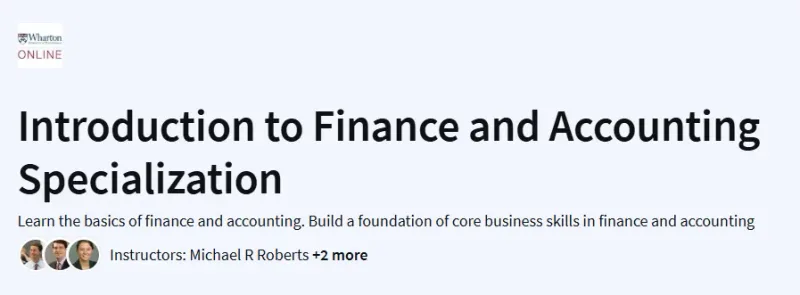
What you will learn in Introduction to Finance and Accounting Specialization Course
-
Understand the fundamentals of Decentralized Finance (DeFi) and how it differs from traditional finance.
-
Explore blockchain technology, smart contracts, and decentralized applications (dApps).
-
Learn about cryptocurrencies, stablecoins, and their role in DeFi ecosystems.
-
Study lending, borrowing, staking, and yield farming strategies in DeFi.
- Gain insights into decentralized exchanges (DEXs) and automated market makers (AMMs).
- Analyze the risks, security challenges, and regulatory considerations of DeFi protocols.
- Work on real-world DeFi projects and case studies to apply your knowledge.
Program Overview
Introduction to Decentralized Finance
⏱️4-6 weeks
- Understand the history of DeFi and how it challenges traditional banking systems.
- Explore centralized vs. decentralized finance models.
- Learn the key benefits and limitations of DeFi.
Blockchain & Smart Contracts in DeFi
⏱️ 6-8 weeks
- Study blockchain fundamentals and how smart contracts enable trustless transactions.
- Gain hands-on experience with Ethereum, Solidity programming, and dApps.
- Explore Layer 1 and Layer 2 scaling solutions for DeFi applications.
DeFi Applications & Financial Services
⏱️ 8-12 weeks
-
Learn how lending and borrowing work in DeFi platforms like Aave and Compound.
-
Explore liquidity pools, yield farming, and staking mechanisms.
-
Understand stablecoins, governance tokens, and DeFi tokenomics.
Decentralized Exchanges (DEXs) & Automated Market Makers (AMMs)
⏱️ 10-12 weeks
-
Study decentralized trading platforms like Uniswap, SushiSwap, and Curve Finance.
-
Understand how AMMs replace traditional order books and enable peer-to-peer trading.
-
Learn about impermanent loss, arbitrage opportunities, and liquidity provision.
DeFi Risks, Security, & Regulatory Landscape
⏱️ 12-15 weeks
-
Identify common DeFi vulnerabilities, including rug pulls, flash loan attacks, and smart contract exploits.
-
Explore DeFi security best practices, audits, and governance mechanisms.
-
Learn about global regulatory challenges, compliance requirements, and the future of DeFi laws.
Capstone Project: Building a DeFi Portfolio
⏱️ 14-16 weeks
- Research and analyze DeFi investment opportunities.
- Develop a personalized DeFi strategy based on risk tolerance and goals.
- Build and present a DeFi portfolio with diversified assets and risk-mitigation strategies.
Get certificate
Job Outlook
-
The DeFi sector is expanding rapidly, with over $50 billion locked in DeFi protocols (as of 2025).
-
Career opportunities include roles such as DeFi Analyst, Blockchain Developer, Smart Contract Engineer, and Crypto Asset Manager.
-
Salaries in DeFi range from $80K – $200K, with top talent commanding six-figure incomes.
-
Companies and startups are actively seeking professionals with expertise in blockchain, DeFi, and Web3 finance.
-
The rise of AI-powered financial automation is expected to further revolutionize DeFi applications.
Explore More Learning Paths
Enhance your finance and accounting knowledge with these curated programs designed to help you understand financial principles, corporate value creation, and practical accounting techniques.
Related Courses
-
Fundamentals of Accounting Specialization Course – Learn core accounting concepts, including bookkeeping, financial statements, and analysis for business decisions.
-
Corporate Finance I: Measuring and Promoting Value Creation Course – Understand how companies create value, manage capital, and make financial decisions to drive growth.
-
Finance for Non-Finance Professionals Course – Gain practical financial skills to interpret reports, budgets, and business performance without prior finance experience.
Related Reading
Gain deeper insight into how financial knowledge underpins business success:
-
What Is Wealth Management? – Understand strategies for managing, growing, and preserving financial assets effectively.