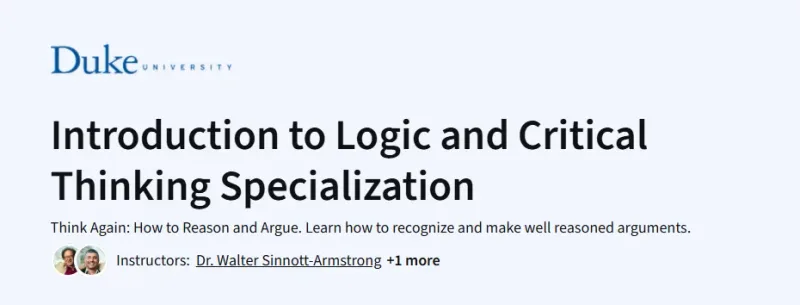
What will you learn in Introduction to Logic and Critical Thinking Specialization Course
-
Develop analytical thinking to identify flawed reasoning and deceptive arguments.
-
Apply logical frameworks like deduction, induction, and argument structure.
-
Recognize common fallacies in everyday and academic contexts.
-
Evaluate evidence and construct valid, well-supported arguments.
Program Overview
Course 1: Think Again I: How to Understand Arguments
-
⏱️ 4 weeks
-
Topics: Recognizing arguments, premises vs conclusions, argument reconstruction.
-
Hands-on: Practice identifying arguments from everyday situations.
Course 2: Think Again II: How to Reason Deductively
-
⏱️ 4 weeks
-
Topics: Validity, truth tables, logic symbols, and deduction.
-
Hands-on: Construct and assess deductive arguments using logical notation.
Course 3: Think Again III: How to Reason Inductively
-
⏱️ 4 weeks
-
Topics: Inductive strength, analogical reasoning, generalizations, and causal arguments.
-
Hands-on: Apply statistical reasoning and assess probabilities.
Course 4: Think Again IV: How to Avoid Fallacies
-
⏱️ 4 weeks
-
Topics: Common fallacies (ad hominem, straw man, slippery slope), fallacy detection.
-
Hands-on: Analyze flawed arguments in media and discussions.
Get certificate
Job Outlook
-
Valuable in law, politics, academia, consulting, public speaking, and AI/tech.
-
Strong demand for professionals with analytical and logical reasoning skills.
-
Enhances academic writing, policy analysis, and debate abilities.
-
Useful for preparing for law school, GRE, or public policy roles.
Explore More Learning Paths
Strengthen your analytical abilities with these hand-picked courses designed to deepen your reasoning, decision-making, and problem-solving skills.
Related Courses
-
Model Thinking Course – Learn how models help you better interpret data, predict outcomes, and understand complex systems.
-
Critical Thinking Skills for University Success Course – Build essential reasoning, argumentation, and academic evaluation skills.
-
Mindware: Critical Thinking for the Information Age Course – Master practical cognitive tools to make smarter decisions in a data-rich world.
Related Reading
Gain deeper insight into how knowledge is structured, organized, and leveraged for better decision-making:
-
What Is Knowledge Management? – Explore how organizations create, share, and apply knowledge to improve performance and problem-solving.